🧪 Elements, Compounds, & Mixtures : ⚛ Atoms : 💥 Atomic Bonding & Chemical Reactions : ☢️ Atomic Bomb : 👩🏻🔬 pH, Acids, & Bases



🥼Becoming a Scientist
- a collection of activities to use at the start of the school year posted on my “Properties of Matter” page.
🧪 Elements, Compounds, and Mixtures (back to top)
- Teachers Pet -👩🏻💻 these are FANTASTIC short animated videos that explain many concepts for middle school level chemistry (YouTube)
- Meet the Elements Song (YouTube)
- Vocabulary – cut and paste activies and templates in Google Drive (blog entry)
- Elements, Compounds, and Mixtures Classification Group Activity (blog entry)
- Includes a whole class activity where students can guess if a substance is an Element, Compound, or Mixture
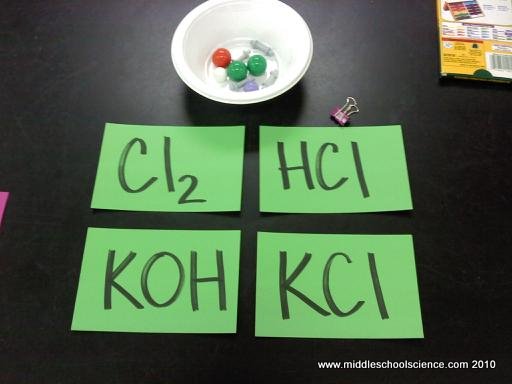
- E, C, M Reinforcement & Quiz, Quiz, Trade Activity– students will learn to identify E, C,Ms using molecular models (blog entry)
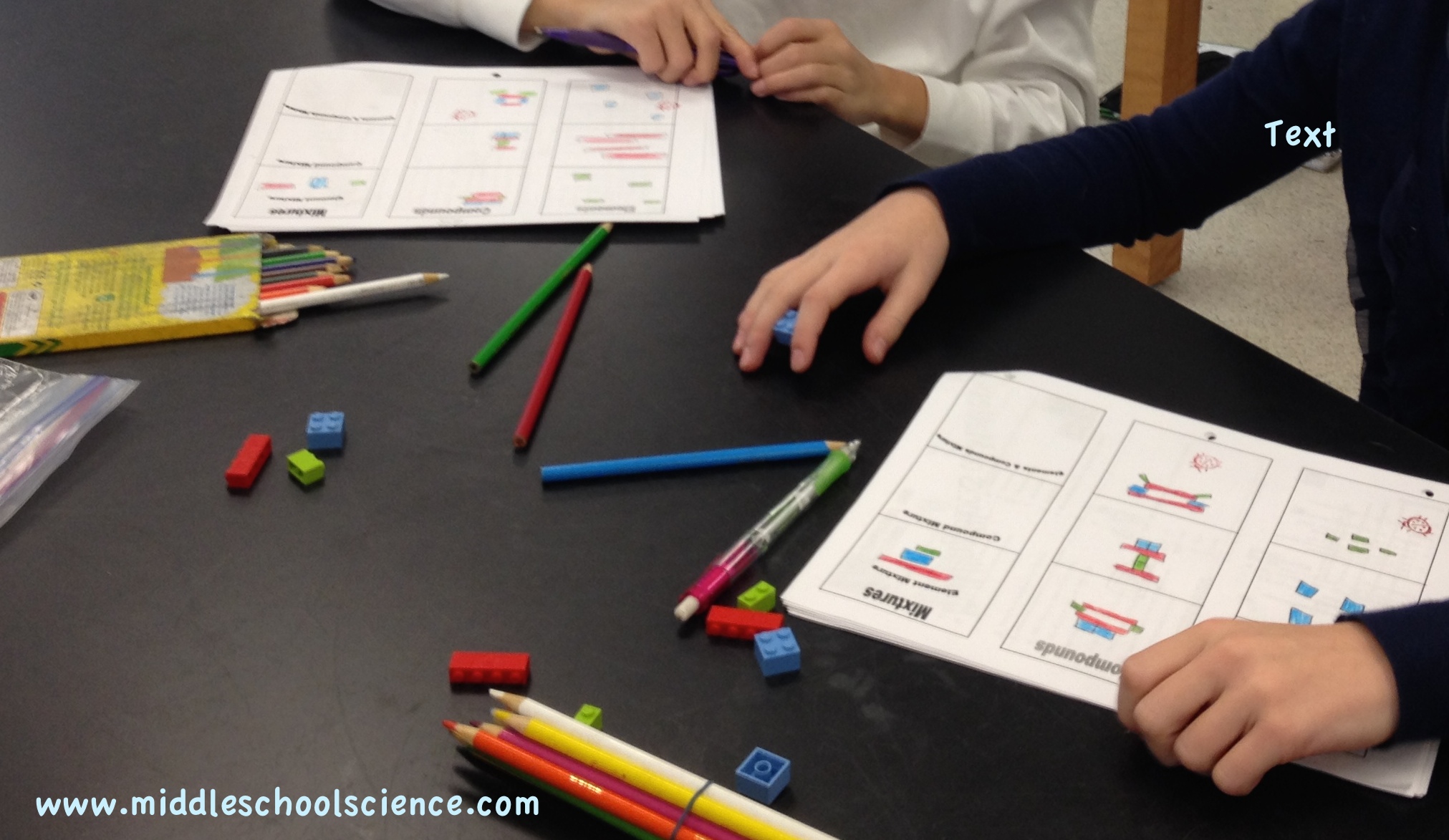
- Lego Activity: Using Legos to represent Elements, Compounds, and Mixtures (Blog Entry)
- Rainbow Lab: Students will make the colors of the rainbow and their own designer colors using food coloring. Fantastic lesson for making mixtures and practicing using a graduated cylinder for liquid volume (blog entry)
- Chromatography Lab (pdf) – students will separate the dyes found in markers
- Properties of Matter Study Guide (Google slides)
Advertisements
⚛ Atoms (back to top)
- Mystery Sock (blog entry) – student will practice using indirect evidence
- Atomic Theory Timeline: How do we make a model of something we can’t see? (blog entry)
- “Atoms Family” – practice finding Protons, Neutrons, Electrons, Atomic Number, and Atomic Mass and singing about it 🎶 (blog entry)
- Adopt An Element – 🎨 create an advertisement for your favorite element (blog entry)
- Periodic Table Reference Handout (pdf) this is my favorite periodic table to use with my students
- Additional Periodic Table Links
- Periodic Videos 📽 or the Ted-Ed Version
- LOVE this website, they have videos for each element and the kids really enjoy them
- Coloring the Periodic Table – students will learn how the periodic table is set up (blog entry)
- Periodic Table Battleship – a fun way to learn where the elements are located (blog entry)
- Elements Bingo – play a fun game of Bingo to practice finding elements (blog entry)
- Valence Electrons – How to determine the number of valence electrons and shells using the element’s group number and period (blog entry)
- Bohr Diagrams: How to draw Bohr diagrams for elements 1-20 (blog entry)
- Lewis Structures: How to draw Lewis Structures for elements in Groups 1-8 (blog entry)
- Reviewing the patterns of the Periodic Table – can be used as a whole class or self paced review (Google Slides view only)
Advertisements
💥 Atomic Bonding & Chemical Reactions (back to top)
- Reading Formulas and Counting Atoms – students will practice reading formulas and counting atoms (blog entry)
- Ionic & Covalent Bonding – Students will learn how atoms form Ionic & Covalent bonds (blog entry)
- Bond with a classmate activity – an active way to practice bonding and naming binary compounds (blog entry)
- Making Molecular Models Activity – students will practice how to read formulas, practice Ionic and Covalent bonding, create models to show atomic structure, and have a better understanding of basic chemistry (blog entry)
- Balancing Chemical Equations Activity – one of my long time favorite activities. Students will learn how to read formulas, count atoms, create and read chemical equations, and balance chemical equations using a hands on activity with color coded formulas. (blog entry)
- Identifying and Balancing Chemical Reactions – students will learn to identify the four types of chemical reactions (Synthesis, Decomposition, Single Replacement, & Double Replacement) and balance the equations. (blog entry)
Advertisements
☢️ Atomic Bomb (back to top)
- Einstein’s letter to President Franklin Roosevelt – from the FDR library
- FDR’s letter to Einstein – from the Atomic Archive
- Duck and Cover – 1950’s safety video for students on what to do in case of nuclear attack
- Fake Towns – “Doom Towns” set up for nuclear testing
- Every nuclear detonation – this is a fascinating graphical representation of nuclear detonations that I showed to my students as part of our history of the Atomic Bomb Unit
- “Fat Man and Little Boy” – Clips from the classic 1989 movie about the race to the atomic bomb.
- How the Atomic Bomb Impacted American Culture – part of the Cold War documentary series
- Crash Course – The Atomic Bomb
- Modern Marvels – The Manhattan Project
👩🏻🔬 pH, Acids, and Bases (back to top)
- Acids & Bases Venn Diagram: What are the properties of Acids & Bases? (Blog entry)
- Cabbage Juice Lab – students will use Cabbage Juice as a pH indicator to test the pH of various household items. (blog entry)
- “Alien Juice Bar” -🧑🏻💻 a great interactive site where students have to serve juices to aliens, if they give them the wrong juice, the aliens get sick, or worse! (blog entry)
- Mystery Powder Labs – student will complete a series of tests (pH, heat, vinegar, iodine) to identify different mystery powders – worksheet (pdf) and flow chart (pdf).
🧪 Elements, Compounds, & Mixtures : ⚛ Atoms : 💥 Atomic Bonding & Chemical Reactions : ☢️ Atomic Bomb : 👩🏻🔬 pH, Acids, & Bases
Advertisements
————–Links on this page were checked and updated on 4.5.25———-

